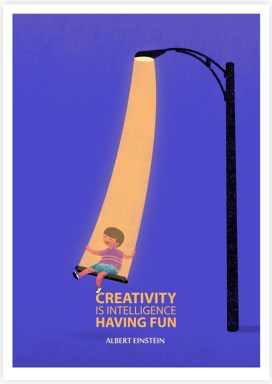
 Creativity in schools, it sounds almost contradictive. Stop and ask, what remains the goal of public education in the United States? Based on the emphasis placed on state exams, one would likely conclude the goal of public education exists to teach students how to take English and Mathematics tests. Where does creativity fit into the hierarchy of education? That depends on the teacher.
Nieto (2015) pointed out that teachers feel a loss of professional autonomy and the pressure of high-stakes testing. One might even ask, why become a teacher today? Media reports compound a general lack of respect for the profession and educators take the brunt of their criticism (Nieto, 2015). So why do teachers still teach? Educators want to make a difference in children’s lives, and in today’s world of education, that demands creativity.
Educators possess the ability to allow for teaching creativity in their classrooms, but it takes creativity on their own part. The U.S. education system does not support creativity. If anything, it discourages it. The system rewards memorization and understanding, not learning. The word learning implies doing. However, the state cannot test doing. Ravitch and Córtese (2009) said, “American students consistently have ranked below those from Finland, Canada, Japan, and at least a dozen other industrialized nations on international tests of mathematics, science, and reading.” When one takes a closer look at the national standards in these countries, they can see why. “While American students are spending endless hours preparing to take tests of their basic reading and math skills, their peers in high-performing nations are reading poetry and novels, conducting experiments in chemistry and physics, making music, and studying important historical issues” (Ravitch & Córtese, 2009).
For the U.S. education system to allow creativity, teachers must possess more autonomy. Simply put, allow teachers to teach and stop worrying about a test. Some argue that educators should start formal lessons in creativity, which would of course lead to formal testing of this skill and compound the problem further. Children do not need lessons in creativity or testing over it. Children possess natural creativity. Our education system needs to trust that educators can teach and allow children to develop their creative abilities. Sir Ken Robinson (2014) said, “I think great education is about creating conditions under which people want to learn and be encouraged and stimulated and provoked…Teachers can’t make children learn. They have to create conditions where kids want to learn and teachers can do their job properly.”
Christine McGraw, Teacher
HSU Masters in Gifted Education Student
References
Developing individual talent and abilities: An Interview with Sir Ken Robinson. (2014). Language Arts, 92(2), 157.
Nieto, S. (2015). Still teaching in spite of it all. Educational Leadership, 72(6), 54.
Ravitch, D., & Cortese, A. (2009). WHY WE’RE BEHIND: What top nations teach their students but we don’t. Education Digest, 75(1), 35.

 Ponderings