
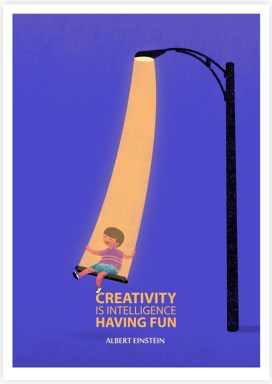
 Creativity in schools, it sounds almost contradictive. Stop and ask, what remains the goal of public education in the United States? Based on the emphasis placed on state exams, one would likely conclude the goal of public education exists to teach students how to take English and Mathematics tests. Where does creativity fit into the hierarchy of education? That depends on the teacher.
Nieto (2015) pointed out that teachers feel a loss of professional autonomy and the pressure of high-stakes testing. One might even ask, why become a teacher today? Media reports compound a general lack of respect for the profession and educators take the brunt of their criticism (Nieto, 2015). So why do teachers still teach? Educators want to make a difference in children’s lives, and in today’s world of education, that demands creativity.
Educators possess the ability to allow for teaching creativity in their classrooms, but it takes creativity on their own part. The U.S. education system does not support creativity. If anything, it discourages it. The system rewards memorization and understanding, not learning. The word learning implies doing. However, the state cannot test doing. Ravitch and Córtese (2009) said, “American students consistently have ranked below those from Finland, Canada, Japan, and at least a dozen other industrialized nations on international tests of mathematics, science, and reading.” When one takes a closer look at the national standards in these countries, they can see why. “While American students are spending endless hours preparing to take tests of their basic reading and math skills, their peers in high-performing nations are reading poetry and novels, conducting experiments in chemistry and physics, making music, and studying important historical issues” (Ravitch & Córtese, 2009).
For the U.S. education system to allow creativity, teachers must possess more autonomy. Simply put, allow teachers to teach and stop worrying about a test. Some argue that educators should start formal lessons in creativity, which would of course lead to formal testing of this skill and compound the problem further. Children do not need lessons in creativity or testing over it. Children possess natural creativity. Our education system needs to trust that educators can teach and allow children to develop their creative abilities. Sir Ken Robinson (2014) said, “I think great education is about creating conditions under which people want to learn and be encouraged and stimulated and provoked…Teachers can’t make children learn. They have to create conditions where kids want to learn and teachers can do their job properly.”
Christine McGraw, Teacher
HSU Masters in Gifted Education Student
References
Developing individual talent and abilities: An Interview with Sir Ken Robinson. (2014). Language Arts, 92(2), 157.
Nieto, S. (2015). Still teaching in spite of it all. Educational Leadership, 72(6), 54.
Ravitch, D., & Cortese, A. (2009). WHY WE’RE BEHIND: What top nations teach their students but we don’t. Education Digest, 75(1), 35.

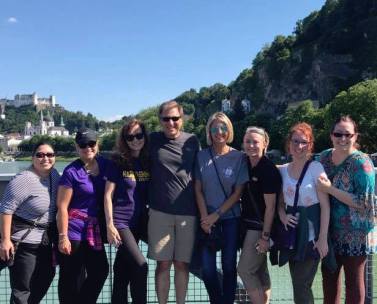 gram’s residency requirement, my grandfather passed away. In my grief, I never felt alone; my cohort (and the 2014 cohort) surrounded me with so much love and support. They helped me through such a difficult time, and I was able to complete the residency and course requirements during a time of great stress. I had never known this amount of support before. Despite everything, after three years in the program, I can honestly say that the leap of faith I took in 2015 has resulted in my greatest adventure yet. This program challenged me to break out of my shell and show the world what I have to offer. I have pushed myself beyond what I thought I was capable of doing so many times throughout the years. I do not think I would have the confidence that I have today if it was not for this doctoral program. And, my adventure is not over. I still have another year of growth, learning, creating, and contributing to the field. I look forward to what the future holds.
 ne be a leader? Don’t some individuals choose to follow and support the leader’s strategic goals? Regardless, some people do rise to the top of an organization or mission to serve in a leadership role. But are they prepared to do that well? Do they have the knowledge and expertise to caste a vision, develop a strategic plan, enlist the best people to work with them, and guide the collaborative effort to move in a new direction or achieve the goal?
 historical leaders to determine their effectiveness while also considering the ethics of their decisions and behavior. They investigate the impact of servant leadership in today’s world while remembering the best servant leader, Jesus Christ. They study leadership in varied settings from their workplace to travel course sites of Austin, Washington DC, and Austria and Germany. They culminate their study in an individual research study that results in a dissertation but also fulfills their passionate interest. Along the way, they develop life-long friends and colleagues within and among cohort groups formed in the program.
 ach others to lead well? If so, visit our website at


 s. First, disbelief. Second, I would have felt intensely energized by the accomplishments. The simple decision to walk in faith instead of fear forever changed my life. I was afraid of the work, the time commitment, and the cost. Rather than allow my uncertainty to guide my decision, I listened to my heart and accepted the challenge of this doctorate degree. In return, I received the direction and confidence I needed to live the life I imagined through my business. I am forever grateful.


 Corporatization of American higher education institutions produces multiple opportunities for unethical practices in recruitment and admissions as institutions compete for students. Viewing higher education through a business model lens helps to improve rankings and increase enrollment, however “is it wise to redirect the efforts” of staff and faculty away from the “core responsibility” (Natale & Doran, 2012, p. 187) of education? Treating education as a commodity designed to meet students’ and families’ expectations of career attainment opens the door to corporatization of American higher education (Blumenstyk, 2015; Selingo, 2013). “The quest for high ethics standards in education is a goal never permanently achieved” (Johnson, 2012, p. 493) which constitutes a need for ethical considerations related to recruiting and admission practices, college matching, undocumented and international students, and institutional marketing strategies.



 Ponderings